

What To Wear When Cleaning Stinging Nettle
| Urtica dioica | |
|---|---|
 | |
| Urtica dioica subsp. dioica | |
Scientific classification  | |
| Kingdom: | Plantae |
| Clade: | Tracheophytes |
| Clade: | Angiosperms |
| Clade: | Eudicots |
| Clade: | Rosids |
| Club: | Rosales |
| Family: | Urticaceae |
| Genus: | Urtica |
| Species: | U. dioica |
| Binomial proper noun | |
| Urtica dioica L.[one] | |
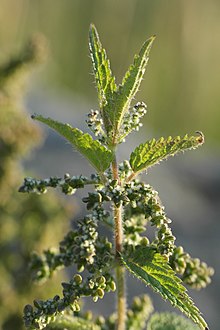
Urtica dioica , oft known every bit common nettle, burn nettle, stinging nettle (although not all plants of this species sting) or nettle leaf, or just a nettle or stinger, is a herbaceous perennial angiosperm in the family Urticaceae. Originally native to Europe, much of temperate Asia and western North Africa,[1] it is at present found worldwide, including New Zealand[two] and N America.[3] [4] The species is divided into six subspecies, five of which accept many hollow stinging hairs called trichomes on the leaves and stems, which act like hypodermic needles, injecting histamine and other chemicals that produce a stinging sensation upon contact ("contact urticaria", a form of contact dermatitis).[5] [vi]
The constitute has a long history of use as a source for traditional medicine, nutrient, tea, and material raw cloth in aboriginal (such as the Saxons) and modern societies.[1] [vii]
Description [edit]
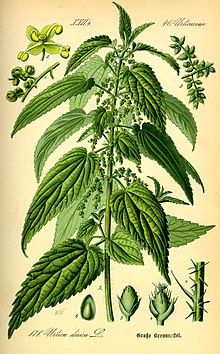
Urtica dioica from Thomé, Flora von Federal republic of germany, Österreich und der Schweiz, 1885
Urtica dioica is a dioecious, herbaceous, perennial constitute, one to 2 yard (3 to 7 ft) tall in the summer and dying down to the ground in winter.[3] It has widely spreading rhizomes and stolons, which are bright yellow, as are the roots. The soft, light-green leaves are three to 15 cm (ane to 6 in) long and are borne oppositely on an erect, wiry, green stem. The leaves have a strongly serrated margin, a cordate base, and an acuminate tip with a terminal leaf tooth longer than adjacent laterals. Information technology bears small, greenish or brownish, numerous flowers in dense axillary inflorescences.
The leaves and stems are very hairy with non-stinging hairs, and in most subspecies, as well bear many stinging hairs (trichomes or spicules), whose tips come up off when touched, transforming the hair into a needle that can inject several chemicals causing a painful sting or paresthesia, giving the species its mutual names: stinging nettle, burn-nettle, burn down-weed, or burn down-hazel.[3] [v] [4]

Taxonomy [edit]
The taxonomy of Urtica species has been confused, and older sources are likely to utilize a diversity of systematic names for these plants. Formerly, more species were recognised than are now accepted. However, at least half dozen clear subspecies of U. dioica are described, some formerly classified as separate species:
- U. dioica subsp. dioica (European stinging nettle), from Europe, Asia, and northern Africa, has stinging hairs.
- U. dioica subsp. galeopsifolia (fen nettle or stingless nettle), from Europe, does not accept stinging hairs.
- U. dioica subsp. afghanica, from southwestern and central Asia, sometimes has stinging hairs or is sometimes hairless.[viii]
- U. dioica subsp. gansuensis, from eastern Asia (China), has stinging hairs.[8]
- U. dioica subsp. gracilis (Ait.) Selander (American stinging nettle), from North America, has stinging hairs and is monoecious.
- U. dioica subsp. holosericea (Nutt.) Thorne (hoary stinging nettle), from North America, has stinging hairs and is monoecious.[9]
Other species' names formerly accustomed every bit distinct by some authors simply at present regarded equally synonyms of one or other subspecies include U. breweri, U. californica, U. cardiophylla, U. lyalli, U. major, U. procera, U. serra, U. strigosissima, U. trachycarpa, and U. viridis.
Distribution [edit]
Urtica dioica is considered to be native to Europe, much of temperate Asia and western North Africa.[1] It is abundant in northern Europe and much of Asia, usually found in the countryside.[ citation needed ] It is less widespread in southern Europe and north Africa, where information technology is restricted past its need for moist soil, but is still common. Information technology has been introduced to many other parts of the world. In North America, it is widely distributed in Canada and the United States, where it is found in every province and state except for Hawaii, and also can be found in northernmost Mexico. It grows in abundance in the Pacific Northwest, especially in places where annual rainfall is loftier. The European subspecies has been introduced into Australia, Northward America and South America.[ten] [eleven]
In Europe, nettles have a stiff association with human habitation and buildings. The presence of nettles may indicate the site of a long-abandoned edifice, and can too indicate soil fertility.[12] Human and animal waste may be responsible for elevated levels of phosphate[13] and nitrogen in the soil, providing an ideal environment for nettles.
Ecology [edit]

A stinging nettle growing in a field
Nettles are the larval food plant for several species of butterflies, such as the peacock butterfly,[14] comma (Polygonia c-album), and the small tortoiseshell. It is likewise eaten past the larvae of some moths including angle shades, buff ermine, dot moth, the flame, the gothic, grey chi, grey pug, lesser broad-bordered yellow underwing, mouse moth, setaceous Hebrew character, and small angle shades. The roots are sometimes eaten by the larva of the ghost moth (Hepialus humuli).
Stinging nettle is particularly constitute equally an understory plant in wetter environments, but it is also found in meadows. Although nutritious, it is not widely eaten by either wildlife or livestock, presumably because of the sting. It spreads by arable seeds and too past rhizomes, and is often able to survive and re-establish quickly after fire.[15]
Nettle sting mechanism and handling [edit]

U. dioica close-upwardly of the defensive hairs
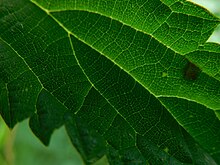

A manus with nettle dermatitis
Urtica dioica produces its inflammatory effect on skin (stinging, burning sensation often called "contact urticaria") both by impaling the skin via spicules – causing mechanical irritation – and by biochemical irritants, such every bit histamine, serotonin, and acetylcholine, amongst other chemicals.[5] [16] [17] [18] [19] Anti-itch drugs, usually in the course of creams containing antihistamines or hydrocortisone, may provide relief from nettle dermatitis.[5] The term, contact urticaria, has a wider use in dermatology, involving dermatitis caused by various pare irritants and pathogens.[xx]
Docks, especially the broad-leaf dock (Rumex obtusifolius) ofttimes grow in like environments to stinging nettles and are regarded as a folk remedy to counteract the sting of a nettle,[21] although there is no bear witness of any chemical result. It may be that the human action of rubbing a dock leaf against a nettle sting acts equally a distracting counterstimulation, or that belief in the dock's upshot provides a placebo effect.[22]
Influence on language and culture [edit]
In Great Britain and Republic of ireland, the stinging nettle U. dioica and the annual nettle Urtica urens are the only common stinging plants and accept institute a place in several figures of speech in the English language. Shakespeare's Hotspur urges that "out of this nettle, danger, we pluck this bloom, safety" (Henry 4, office 1, Human action II Scene 3). The figure of speech communication "to grasp the nettle" probably originated from Aesop'south legend "The Boy and the Nettle".[23] In Seán O'Casey's Juno and the Paycock, one of the characters quotes Aesop "Gently touch a nettle and information technology'll sting yous for your pains/Grasp it every bit a lad of mettle and soft every bit silk remains". The metaphor may refer to the fact that if a nettle plant is grasped firmly rather than brushed against, it does non sting so readily, considering the hairs are crushed down apartment and practice not penetrate the skin so easily.[24]
In the High german language, the idiom sich in die Nesseln setzen, or to sit in nettles, means to get into trouble. In Hungarian, the idiom csalánba nem üt a mennykő, the thunderbolt does not strike into nettle, means bad people escape trouble or the devil looks subsequently his own.[25] The same idiom exists in the Serbian language - неће гром у коприве. In Dutch, a netelige situatie means a predicament. In French, the idiom faut pas pousser mémé dans les orties (don't button granny into the nettles) means that we should be careful not to abuse a state of affairs. The name urticaria for hives comes from the Latin proper noun of nettle (Urtica, from urere, to burn).
The English word 'nettled', pregnant irritated or angry, is derived from 'nettle'.[26]
There is a common idea in Smashing Britain that the nettle was introduced by the Romans.[27] The idea was mentioned by William Camden in his book Britannia of 1586.[28] Withal, in 2011, an early Bronze Age burial cist on Whitehorse Hill,[29] [30] Dartmoor, Devon was excavated. The cist dated from between 1730 and 1600 BC. It contained various high value beads equally well as fragments of a sash made from nettle fibre. It is possible that the sash was traded from mainland Europe, but perhaps more than probable that it was locally fabricated.
Uses [edit]
Culinary utilize [edit]

U. dioica has a flavour similar to spinach mixed with cucumber when cooked, and is rich in vitamins A and C, iron, potassium, manganese, and calcium. Immature plants were harvested by Native Americans and used as a cooked constitute in spring when other food plants were scarce.[31] Soaking stinging nettles in water or cooking removes the stinging chemicals from the found, which allows them to exist handled and eaten without injury.[32] Afterward the stinging nettle enters its flowering and seed-setting stages, the leaves develop gritty particles called cystoliths, which tin can irritate the kidneys and urinary tract.[31] [33] : 106–107 Cystoliths are fabricated of calcium carbonate, and will not dissolve when boiled. Leaves harvested mail service-flowering must take their cystoliths broken down by acid, as in the fermentation process. In its tiptop season, nettle contains up to 25% protein, dry weight, which is high for a leafy green vegetable.[34] The leaves are also dried and may then be used to brand a herbal tea, as can also be done with the nettle'due south flowers.
Nettles can be used in a variety of recipes, such as polenta, pesto, and purée.[35] Nettle soup is a common use of the plant, specially in Northern and Eastern Europe.
Nettles are sometimes used in cheesemaking, for instance in the production of Cornish Yarg[36] and equally a flavouring in varieties of Gouda.[37]
Nettles are used in Montenegro, Serbia and Bosnia and Hercegovina as role of the dough filling for the börek pastry. The height baby leaves are selected and simmered, so mixed with other ingredients such equally herbs and rice, before being used equally a filling betwixt dough layers.[38] [39] Similarly, in Hellenic republic the tender leaves are frequently used, after simmering, as a filling for hortopita, which is like to spanakopita, but with wild greens rather than spinach for filling.[40]
Young nettles can also exist used to make alcoholic beer.[41]
Competitive eating [edit]
In the UK, an annual World Nettle Eating Championship draws thousands of people to Dorset, where competitors attempt to eat every bit much of the raw plant equally possible. Competitors are given threescore cm (24 in) stalks of the establish, from which they strip the leaves and eat them. Whoever strips and eats the most stinging nettle leaves in a stock-still time is the winner. The competition dates back to 1986, when two neighbouring farmers attempted to settle a dispute most which had the worst infestation of nettles, and one of them said, "I'll eat any nettle of yours that's longer than mine."[42] [43]
Traditional medicine [edit]
As Old English language stiðe, nettle is ane of the 9 plants invoked in the pagan Anglo-Saxon Nine Herbs Charm, recorded in 10th century traditional medicine. Nettle was believed to be a galactagogue – a substance that promotes lactation.[44] Urtication, or flogging with nettles is the process of deliberately applying stinging nettles to the skin to provoke inflammation. An agent thus used was considered to exist a rubefacient (something that causes redness), used as a folk remedy for treating rheumatism.[45]
Chastisement [edit]
In ethnic justice systems in Republic of ecuador, urtication was used as punishment for astringent crimes in 2010. The sentenced perpetrator of a law-breaking was flogged with stinging nettle, in public, naked, whilst beingness showered with freezing cold water.[46]
Textiles and fibre [edit]

Nettle fibre, stem, yarn, material, jewellery with glass and nettle yarn
Nettle stems contain a bast fibre that has been traditionally used for the same purposes as linen and is produced by a similar retting process. Unlike cotton, nettles abound easily without pesticides. The fibres are coarser, yet.[47]
Historically, nettles have been used to make habiliment for most 3,000 years, as ancient nettle textiles from the Statuary Age accept been found in Kingdom of denmark.[48] Information technology is widely believed that German Army uniforms were almost all made from nettle during Globe State of war I due to a potential shortage of cotton, although there is little evidence to support this.[49] More recently, companies in Austria, Germany, and Italia accept started to produce commercial nettle textiles.[50] [51]
The fibre content in nettle shows a high variability and reaches from below one% to 17%. Under centre-European conditions, stems yield typically between 45 and 55 dt / ha (decitons per hectare), which is comparable to flax stem yield. Due to the variable fibre content, the fibre yields vary between 0.2 and 7 dt / ha, but the yields are normally in the range between 2 and 4 dt / ha.[52] Fibre varieties are normally cloning varieties and therefore planted from vegetative propagated plantlets. Direct seeding is possible, merely leads to great heterogeneity in maturity.[53]
Nettles may be used every bit a dye-stuff, producing yellow from the roots, or xanthous green from the leaves.[54]
Feed [edit]
Nutrient contents [edit]
Fresh leaves contain approximately 82.4% water, 17.six% dry out matter, v.5% protein, 0.7 to iii.3% fatty, and 7.1% carbohydrates.[55] Mature leaves contain nigh forty% α- linolenic acrid, a valuable omega-3 acid.[56] For verbal fat acid contents see Table one. Seeds contain much more fat acid than leaves.[56]
| Mature leaves | Young leaves | Seeds | Stems | Roots | ||
|---|---|---|---|---|---|---|
| Moisture (% fresh weight) | 72.eight (±5.1) | 82.0 (±3.vii) | 47.6 (±2.ane) | 50.1 (±ii.4) | 40.iii (±2.8) | |
| Saponifiable oil (% fresh weight) | ii.1 (±0.iii) | three.three (±0.2) | 15.1 (±2.0) | 1.5 (±0.i) | 0.1 (±0.0) | |
| Fatty acids (% of saponifiable oil) | ||||||
| Palmitic | 16:0 | 17.ix (±1.1) | 20.1 (±0.nine) | 25.4 (±1.9) | 23.6 (±2.1) | 24.0 (±0.8) |
| Palmitoleic | 16:1n-7 | 3.0 (±0.2) | three.9 (±0.3) | 0.vii (±0.0) | 0.5 (±0.0) | two.6 (±0.three) |
| Stearic | 18:0 | 1.half dozen (±0.3) | one.9 (±0.one) | 2.3 (±0.3) | 1.8 (±0.2) | 1.half-dozen (±0.i) |
| Oleic | eighteen:1n-9 | one.vii (±0.2) | 2.8 (±0.2) | iv.eight (±0.3) | 2.1 (±0.two) | 8.7 (±0.five) |
| Linoleic | xviii:2n-6 | 11.vi (±1.0) | eighteen.1 (±one.3) | 22.vii (±one.nine) | 33.viii (±2.9) | 34.iii (±ii.7) |
| α- Linolenic | 18:3n-3 | 40.7 (±3.two) | 29.half-dozen (±ii.1) | half-dozen.vi (±4.9) | 12.2 (±1.0) | two.3 (±0.one) |
| Gadoleic | 20:1n-9 | 0.8 (±0.0) | 0.7 (±0.0) | 2.1 (±0.2) | 1.5 (±0.one) | 1.2 (±0.0) |
| Erucic | 22:1n-9 | 0.iv (±0.0) | 0.v (±0.1) | i.2 (±0.2) | 0.ix (±0.2) | 0.nine (±0.i) |
| Omega-three : Omega-6 Ratio | north-3/due north-6 | 3.51 | 1.64 | 0.29 | 0.65 | 0.07 |
Minerals (Ca, Chiliad, Mg, P, Si, S, Cl) and trace elements (Ti, lxxx ppm,[57] Mn, Cu, Fe) contents depend mostly on the soil and the season.[55]
Carotenoids can be found primarily in the leaves, where different forms of lutein, xanthophyll and carotene are present (Table 2). Some carotenes are precursors of vitamin A (retinol), their retinol equivalents RE or retinol activity equivalents per g dry weight are 1.33 for mature leaves and 0.nine for young leaves.[55] Nettle contains much less carotenes and retinol than carrots, which contain 8.35 RE per one thousand fresh weight.[58] Depending on the batch and the leave and stalk content, nettle contains only traces of zeaxanthin or between xx – 60 mg / kg of dry out matter.[55] [59] Nettle contains ascorbic acid (vitamin C), riboflavin (vitamin B2), pantothenic acrid, vitamin Thousand1 [55] and tocopherols (vitamin Due east).[59] The highest vitamin contents tin can be found in the leaves.[55]
| Mature leaves | Immature leaves | ||
|---|---|---|---|
| Total identified carotenoids | 74.8 | 51.4 | |
| Xanthophylls | Neoxanthin | 5.0 (±0.two) | 2.6 (±0.2) 0 |
| Violaxanthin | xi.0 (±0.2) | vii.ii (±0.6) | |
| Zeaxanthin | traces | traces | |
| β-cryptoxanthin | traces | traces | |
| Luteins | 13-cis-lutein | 0.iv (±0.0) | 0.4 (±0.0) |
| 13'-cis-lutein | eight.four (±0.iv) | 5.0 (±0.half-dozen) | |
| All-trans-lutein | 32.4 (±1.0) | 23.half-dozen (±0.8) | |
| 9-cis-lutein | i.2 (±0.ii) | ane.0 (±0.two) | |
| 9'-cis-lutein | iv.4 (±0.four) | three.iv (±0.6) | |
| Carotenes | All-trans-β-carotene | 5.half-dozen (±0.seven) | three.eight (±0.3) |
| β-carotene-cis-isomers | 4.8 (±0.2) | iii.2 (±0.ii) | |
| Lycopene | one.6 (±0.1) | 1.2 (±0.i) | |
| Retinol equivalent | RE / g dry wt | 1.33 (±0.3) | 0.xc (±0.3) |
Poultry: Egg yolk colouring in laying hens [edit]
In laying hens, nettle can be used every bit an egg yolk colorant instead of artificial pigments or other natural pigments (derived from marigold for yellowish). Nettle has loftier carotenoid contents, especially lutein, β-carotene and zeaxanthin, of which lutein and zeaxanthin act as yellow pigments.[59] [60] [61] Feeding equally little every bit 6.25 grand dry out nettle per kg feed is as effective as the synthetic pigments to colour the egg yolk. Feeding nettle has no detrimental outcome on the functioning of the laying hens or on the general quality of eggs.[59]
Ruminants [edit]
Ruminants avert fresh stinging nettles; notwithstanding, if the nettles are wilted or dry, voluntary intake can exist high.[ citation needed ]
| Ryegrass silage | Nettle silage | ||
|---|---|---|---|
| Dry affair | DM | 235 | 415 |
| Metabolizable free energy (MJ/ kg DM) | ME | 11.3 | 9.8 |
| Crude poly peptide | CP | 177 | 171 |
| Neutral detergent fibre | NDF | 536 | 552 |
| Acid detergent fibre | ADF | 338 | 434 |
| Starch | - | - | |
| Ash | 113 | 118 |
Employ in agronomics / horticulture [edit]
In the European Union and United Kingdom, nettle extract can exist used equally a insecticide, fungicide, and acaricide under Basic Substance regulations.[63] As an insecticide nettle extract can be used for the command of codling moth, diamondback moth, and spider mites. As a fungicide, it can be used for the control of Pythium root rot, powdery mildew, early blight, late bane, Septoria blight, Alternaria foliage spot, and grey mould.[64]
Gardening [edit]
Nettles accept a number of other uses in the vegetable garden, including the potential for encouraging benign insects. Since nettles prefer to grow in phosphorus-rich and nitrogen rich soils that have recently been disturbed (and thus aerated), the growth of nettles is an indicator that an area has high fertility (especially phosphate[65] and nitrate[66]), and thus is an indicator to gardeners equally to the quality of the soil.[67] [68]
Nettles contain nitrogenous compounds, so are used equally a compost activator[69] or tin exist used to make a liquid fertilizer, which although low in phosphate, is useful in supplying magnesium, sulphur, and iron.[70] [71] They are likewise one of the few plants that can tolerate, and flourish in, soils rich in poultry droppings.
The stinging nettle is the crimson admiral caterpillar'south main host institute and tin can concenter migrating red admiral butterflies to a garden.[72] U. dioica can be a troubling weed, and mowing can increase plant density.[73] Regular and persistent tilling will greatly reduce its numbers, and the apply of herbicides such every bit ii,iv-D and glyphosate are effective command measures.[73]
Field cultivation [edit]
Sowing and planting [edit]
Three cultivation techniques can be used for the stinging nettle: 1) direct sowing, ii) growing seedlings in nurseries with subsequent transplantation and iii) vegetative propagation via stolons or head cuttings.[74]
- Direct sowing: The seedbed should have a loose and fine structure, but should be reconsolidated using a packer roller imminently prior to sowing.[75] Sowing time tin can exist either in autumn[76] or in spring.[77] Seed density should be 6 kg/ha with row spacing of xxx centimetres (12 in) and 42–fifty cm in autumn and spring, respectively.[75] [76] [78] The disadvantage of direct sowing is that it usually leads to incomplete plant coverage.[75] [78] This drawback tin be mitigated by covering the seedbed with a transparent perforated foil in lodge to improve seed germination.[75] [76] Further, weed command tin be problematic as the stinging nettle has a slow seedling development fourth dimension.[75]
- Growing seedlings: For this technique pre-germinated seeds are sown between mid-/end-Feb and beginning of April and grown in nurseries. Seedlings are grown in tuffs with 3-5 plants / tuff and a seed density of 1.2-1.6 kg / thou tuffs. A fastened germination is achieved by alternating high temperature during daytime (xxx °C for eight h) and lower temperature during night (xx °C for sixteen h).[75] [78] Before transplanting, the seedlings should exist fertilized and acclimated to cold temperatures.[75] Transplantation should start around Mid-April with row spacing of 42–50 centimetres (17–20 in) and plant spacing inside rows of 25–xxx cm.[77] [78]
- Vegetative propagation: Stolons (with several buds) of x cm should be planted from mid-April in a depth of 5–7 centimetres (2.0–2.8 in).[77] Head cuttings are grown in nurseries starting between mid-May and mid-June. Growing tips with two foliage pairs are cutting from the female parent constitute and treated with root-growth inducing hormones. Transplantation can be delayed in comparison to the growing seedling technique.[75]
Greenhouse tillage [edit]
The stinging nettle tin besides be grown in controlled-environment agriculture systems, such as soil-less medium cultivations or aeroponics, which may achieve college yields, standardize quality, and reduce harvesting costs and contagion.[79]
Etymology [edit]
Urtica is derived from a Latin give-and-take meaning 'sting'.[lxxx]
Dioica (δίοικος) is derived from Greek, meaning 'of two houses' (having dissever staminate and pistillate plants; dioecious).[80]
Gallery [edit]
-

Young shoot
-

Flowers (male) tin be yellow.
-

Flowers (male) can be majestic.
-

Flowers (female) can be greenish and white.
-
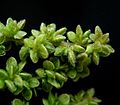
Fruits
-

Caterpillars of Aglais io feeding on Urtica dioica.
Run across also [edit]
- Nettles in folklore
References [edit]
- ^ a b c d "Urtica dioica L." Plants of the Globe Online. Purple Botanic Gardens, Kew. Retrieved 14 November 2018.
- ^ "Stinging nettles". Ministry of Health. 18 September 2014. Retrieved iv May 2019.
- ^ a b c "Urtica dioica - 50". Plants for a Future. 2012. Retrieved 23 April 2018.
- ^ a b "Burning & Stinging Nettles". Academy of California. Retrieved 21 September 2013.
- ^ a b c d "Nettles". Drugs.com. 2009. Retrieved 23 April 2018.
- ^ Per Brodal (2010). The Central Nervous Arrangement: Structure and Function. Oxford University Press U.s.a.. p. 170. ISBN978-0-19-538115-3 . Retrieved 22 September 2010.
- ^ Lukešová, Hana (June 2017). "Identifying plant fibre textiles from Norwegian Merovingian Period and Viking Age graves: The Late Iron Age Collection of the University Museum of Bergen". Journal of Archaeological Scientific discipline: Reports. xiii: 281–285. doi:x.1016/j.jasrep.2017.03.051.
- ^ a b Chen Jiarui; Ib Friis; C. Melanie Wilmot-Love. "Flora of China online". efloras, Missouri Botanical Garden, St. Louis, MO & Harvard University Herbaria, Cambridge, MA.
- ^ "Establish For a Futurity database".
- ^ "Species: Urtica dioica". United States Forest Service. Retrieved 21 September 2013.
- ^ "Stinging Nettle". Ohio Agronomical Research and Development Center, Ohio State University. Retrieved 21 September 2013.
- ^ "Nettles: Bad guys come skilful". The Telegraph Online. 29 Apr 2010. Archived from the original on 12 January 2022. Retrieved 21 February 2019.
- ^ Smith, Paul Fifty. (2012). Indicator Plants: Using Plants to Evaluate the Environment. p. 47.
- ^ Heiko Bellmann: Der Neue Kosmos Schmetterlingsführer, Schmetterlinge, Raupen und Futterpflanzen, pg. 170, Frankh-Kosmos Verlags-GmbH & Co, Stuttgart 2003, ISBN three-440-09330-i.
- ^ Carey, Jennifer H. (1995). "Urtica dioica". Fire Effects Information System, [Online].
- ^ Cummings, Alexander J; Olsen, Michael (2011). "Mechanism of Activeness of Stinging Nettles". Wilderness & Environmental Medicine. 22 (ii): 136–139. doi:10.1016/j.wem.2011.01.001. PMID 21396858.
- ^ Nettle (Stinging). Wildflowerfinder.org.uk. Retrieved on 3 July 2012.
- ^ Louis J. Casarett; Curtis D. Klaassen; John Doull (2008). Casarett and Doull'due south toxicology: the basic science of poisons. McGraw-Hill Professional. pp. 1104–. ISBN978-0-07-147051-three . Retrieved 22 September 2010.
- ^ Michael I. Greenberg (4 June 2003). Occupational, industrial, and environmental toxicology. Elsevier Health Sciences. pp. 180–. ISBN978-0-323-01340-half-dozen . Retrieved 22 September 2010.
- ^ Adisesh, A; Robinson, E; Nicholson, P.J; Sen, D; Wilkinson, M; Standards of Care Working Group (2013). "U.K. Standards of care for occupational contact dermatitis and occupational contact urticaria". British Journal of Dermatology. 168 (half-dozen): 1167–1175. doi:10.1111/bjd.12256. PMC3734701. PMID 23374107.
- ^ "Recorded uses of' dock (Rumex sp.)". Ethnomedica. Archived from the original on 20 November 2008. Retrieved 15 Apr 2008. [ verification needed ]
- ^ Hopcroft, Keith (10 September 2005). "Home remedies: dock leaves for nettle stings". Retrieved 29 August 2020.
- ^ "The Projection Gutenberg eBook of The Æsop For Children, by Æsop". Gutenberg.org. 2 Dec 2006. Retrieved 5 July 2010.
- ^ Doug (five September 2010). "Grasping the nettle: an empirical enquiry". Retrieved half dozen September 2010.
- ^ Bárdosi, Vilmos (2012). Magyar szólások, közmondások adatbázisa (Hungarian sayings, proverbs database) (PDF) (in Hungarian). Budapest: Tinta Könyvkiadó. p. 242. Retrieved 16 March 2019.
- ^ "nettled". Oxford English Lexicon (Online ed.). Oxford University Press. (Subscription or participating institution membership required.)
- ^ "How did the Romans change Britain?". BBC Guides . Retrieved 1 Baronial 2018.
- ^ Lodwick, Lisa (10 April 2014). "Roman nettle – Urtica pilulifera". Lisa Lodwick . Retrieved 1 August 2018.
- ^ "Whitehorse Hill | Dartmoor". www.dartmoor.gov.britain . Retrieved 1 August 2018.
- ^ "The cist on Whitehorse Hill - Electric current Archaeology". Current Archaeology. 1 Dec 2016. Retrieved 1 August 2018.
- ^ a b Gregory L. Tilford, Edible and Medicinal Plants of the Due west, ISBN 0-87842-359-1
- ^ Nyerges, Christopher (2016). Foraging Wild Edible Plants of Due north America: More than 150 Delicious Recipes Using Nature's Edibles. Rowman & Littlefield. p. 130. ISBN978-one-4930-1499-six.
- ^ Renton, Marlow; Biggane, Eric (2019). Foraging Pocket Guide (2020 ed.). Wild Foods UK. ISBN978-1-9999222-2-one.
- ^ Hughes, R. Elwyn; Ellery, Peter; Harry, Tim; Jenkins, Vivian; Jones, Eleri (1980). "The dietary potential of the mutual nettle". Journal of the Science of Food and Agriculture. 31 (12): 1279–86. doi:ten.1002/jsfa.2740311210. PMID 6259444.
- ^ 1069 Recetas de Cocina Archived 5 Feb 2013 at archive.today (No 423). Wattpad.com (12 May 2010). Retrieved on 3 July 2012.
- ^ "Lynher Dairies Nettles & Garlic". Lynherdairies.co.uk. Retrieved 5 July 2010.
- ^ "Gouda Cheese with Stinging Nettles: Cooking Terms". RecipeTips.com. Retrieved 5 July 2010.
- ^ "Byrek me hithra" (in Albanian). Hermes News. 19 March 2012. Archived from the original on 24 Oct 2014. Retrieved 14 May 2017.
- ^ "Byrek me hithra" [Recipe: Nettles Pie] (in Albanian). xiii February 2013. Retrieved 14 May 2017.
- ^ "What's In Your Horta?". Greek Cooking. GreekBoston. 21 June 2015. Retrieved 14 May 2017.
- ^ Wright, John (18 May 2011). "Homebrew from the hedgerow: nettle beer". The Guardian. ISSN 0261-3077. Retrieved 10 April 2020.
- ^ "Earth nettle eating championships". BBC News. 17 June 2005. Retrieved 3 July 2012.
- ^ Langley, William (14 June 2009). "Earth Stinging Nettle Eating Championship attracts tape crowd". The Daily Telegraph. London. Archived from the original on 12 Jan 2022. Retrieved 3 July 2012.
- ^ Westfall, Rachel Emma (2003). "Galactagogue herbs: a qualitative study and review". Canadian Journal of Midwifery Research and Practice. 2 (ii): 22–27.
- ^ "Stinging nettles". BBC . Retrieved 21 September 2013.
- ^ Caselli, Irene (27 July 2010). "Republic of ecuador'due south indigenous justice system on trial". BBC . Retrieved 17 April 2020.
- ^ "Student shows off nettle knickers". BBC News. 1 July 2004. Retrieved 24 May 2010.
- ^ Bergfjord, C. (2012). "Nettle as a singled-out Bronze-Age cloth plant". Scientific Reports. 2: 664. Bibcode:2012NatSR...2E.664B. doi:10.1038/srep00664. PMC3460533. PMID 23024858.
- ^ Edom, G.(2019), From Sting to Spin: A History of Nettle Fibre, Urtica Books
- ^ Neustatter, Angela (27 February 2008). "Rash thinking". The Guardian.
- ^ Flintoff, John-Paul (20 August 2009). "Second skin: why wearing nettles is the next large thing". The Ecologist.
- ^ Wurl, Günter; Graf, Torsten; Vettel, Armin; Biertümpfel, Andrea. "10 Jahre anbautechnische Versuche zu Fasernesseln (Urtica dioica L.) in Thüringen" (PDF). Thüringer Landesanstalt für Landwirtschaft.
- ^ Vogl, C.R; Hartl, A (2009). "Production and processing of organically grown cobweb nettle (Urtica dioica Fifty.) and its potential use in the natural textile industry: A review". American Journal of Alternative Agriculture. 18 (3): 119. doi:10.1079/AJAA200242. S2CID 54916789.
- ^ Piers Warren, 101 uses for Stinging Nettles (2006), p. 65, ISBN 0-9541899-ix-X.
- ^ a b c d e f Lutomski, Jerzy; Speichert, Henryk (1983). "Die Brennessel in Heilkunde und Ernährung". Pharmazie in unserer Zeit (in German language). 12 (half dozen): 181–186. doi:10.1002/pauz.19830120602. PMID 6657715.
- ^ a b c d Guil-Guerrero, J.L; Rebolloso-Fuentes, Grand.M; Isasa, One thousand.E.Torija (2003). "Fatty acids and carotenoids from Stinging Nettle (Urtica dioica L.)". Journal of Food Composition and Analysis. 16 (two): 111–119. doi:10.1016/S0889-1575(02)00172-2.
- ^ Emsley, John (2001). "Titanium". Nature's Building Blocks: An A-Z Guide to the Elements . Oxford, England, UK: Oxford University Press. p. 451. ISBN978-0-19-850340-8.
- ^ "USDA National Nutrient Database: raw carrot". Retrieved 28 November 2015.
- ^ a b c d Loetscher, Y; Kreuzer, M; Messikommer, R.E (2013). "Utility of nettle (Urtica dioica) in layer diets as a natural yellow colorant for egg yolk". Animal Feed Scientific discipline and Technology. 186 (3–4): 158–168. doi:x.1016/j.anifeedsci.2013.x.006.
- ^ Loetscher, Y; Kreuzer, Thou; Messikommer, R. E (2013). "Oxidative stability of the meat of broilers supplemented with rosemary leaves, rosehip fruits, chokeberry pomace, and unabridged nettle, and effects on performance and meat quality". Poultry Science. 92 (11): 2938–2948. doi:10.3382/ps.2013-03258. PMID 24135598.
- ^ Keshavarz, Mehdi; Rezaeipour, Vahid; Asadzadeh, Sakineh (2014). "Growth Performance, Blood Metabolites, Antioxidant Stability and Carcass Characteristics of Broiler Chickens Fed Diets Containing Nettle (Urtica dioica. L) Pulverisation or Essential Oil". International Journal of Avant-garde Biological and Biomedical Research. 2 (nine): 2553–2561. ISSN 2322-4827.
- ^ Humphries, D.J; Reynolds, C.K (2014). "The issue of adding stinging nettle (Urtica dioica) haylage to a total mixed ration on performance and rumen role of lactating dairy cows". Animal Feed Science and Engineering science. 189: 72–81. doi:10.1016/j.anifeedsci.2014.01.006.
- ^ European union. "Concluding Review study for the basic substance Urtica spp. Finalised in the Standing Commission on Plants, Animals, Nutrient and Feed at its meeting on 24 January 2017" (PDF).
{{cite web}}: CS1 maint: url-status (link) - ^ Sharp, Dr Russell (22 November 2021). "Basic Substances; what are they and how tin can they used for pest and disease command on farms?". Eutrema . Retrieved 24 November 2021.
- ^ "Nettles every bit weeds / RHS Gardening". www.rhs.org.great britain . Retrieved 25 March 2022.
- ^ "Mutual nettle | Garden Organic". www.gardenorganic.org.uk . Retrieved 25 March 2022.
- ^ "Indicator Weeds and Soil Conditions at". Garden-helper.com. Retrieved v July 2010.
- ^ "virtual-herb-walk". Herbalpractitioner.com. Retrieved five July 2010.
- ^ "h2g2 – Stinging Nettles". BBC Dna. Retrieved 5 July 2010.
- ^ Pears, Pauline, et al. HDRA Encyclopedia Of Organic Gardening, p. 207, Dorling Kindersley Ltd, London, 2005.
- ^ "Compost Teas vs Other Teas and Extracts". Ciwmb.ca.gov. Retrieved five July 2010.
- ^ Bryant, Simon; Thomas, Chris; Bale, Jeffrey (1997). "Nettle-feeding nymphalid butterflies: Temperature, development and distribution". Ecological Entomology. 22 (4): 390–398. doi:10.1046/j.1365-2311.1997.00082.10. S2CID 84143178.
- ^ a b Wood Powell Anderson (1999). Perennial weeds: characteristics and identification of selected herbaceous species. Wiley-Blackwell. pp. 25–. ISBN978-0-8138-2520-5 . Retrieved 17 October 2010.
- ^ Heyland, Klaus-Ulrich (2006). "Ölfrüchte, Faserpflanzen, Arzneipflanzen und Sonderkulturen". Handbuch des Pflanzenbaues. 4.
- ^ a b c d due east f g h Bomme, U. (1996). "Kulturanleitung für Brennnesseln". Bayerische Landesanstalt für Bodenkultur und Pflanzenbau, Abteilung Pflanzenbau und Pflanzenzüchtung, LBP Freising.
- ^ a b c Heeger, Due east. F. (1956). Handbuch des Arznei- und Gewürzpflanzenbaus. Leipzig: Deutscher Bauernverlag.
- ^ a b c Bomme U.; Unterholzerner S (1996). "Günstigste Verfahren zum Anbau der Grossen Brennnessel". Gemüse. 3: 233–234.
- ^ a b c d Dachler G.; Pelzmann H. (1999). "Arznei- und Gewürzpflanzen". Anbau — Ernte — Aufbereitung. 2. Auflage.
- ^ Pagliarulo, C.Fifty; Hayden, A.L; Giacomelli, One thousand.A (2004). "Potential for Greenhouse Aeroponic Cultivation of Urtica Dioica". Acta Horticulturae (659): 61–66. doi:x.17660/ActaHortic.2004.659.6. S2CID 14875913.
- ^ a b Gledhill, David (2008). "The Names of Plants". Cambridge University Press. ISBN 9780521866453 (hardback), ISBN 9780521685535 (paperback). pp 142, 395
Further reading [edit]
- Elliott, C. (1997). "Rash Encounters". Horticulture. 94: 30.
- Schofield, Janice J. (1998). Nettles ISBN 0-585-10500-6
- Thiselton-Dyer, T. F., (1889). The Folk-Lore of Plants.
- Glawe, G. A. (2006). Sex ratio variation and sex determination in Urtica diocia. ISBN ninety-6464-026-ii
External links [edit]
- "Urtica dioica L." Germplasm Resources Data Network (Grinning). Agricultural Research Service (ARS), United States Department of Agronomics (USDA).
- Flora of China: Urtica dioica

Source: https://en.wikipedia.org/wiki/Urtica_dioica
Posted by: nicholsonmusere.blogspot.com
0 Response to "What To Wear When Cleaning Stinging Nettle"
Post a Comment